

Voting Barriers Persist Ahead of the U.S. Midterm Elections

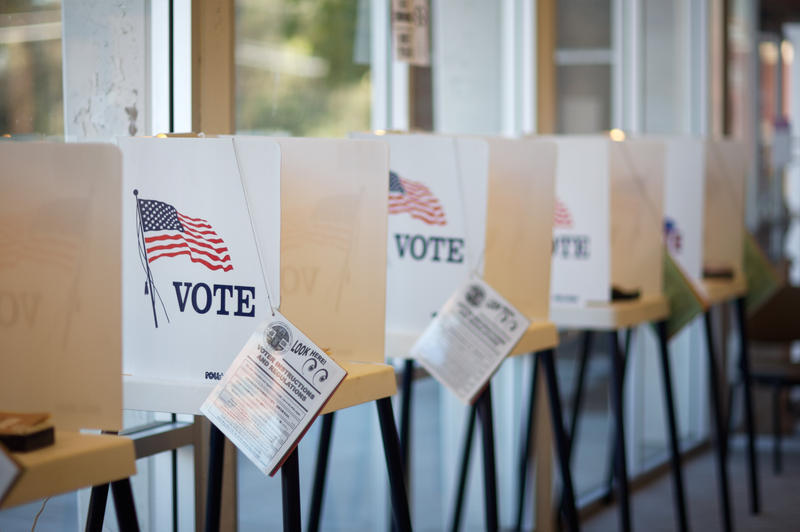
Voting booths at Hermosa Beach City Hall during California Primary
Alenteshar Al Arabi
Speakers at an American Community Media briefing warned that voters from minority communities continue to face barriers ahead of the November 3 midterm elections. They discussed difficulties with voter registration and obtaining identification, reduced access to ballot drop boxes and polling places, the effects of redistricting, and concerns among some voters about the possible presence of Immigration and Customs Enforcement (ICE) agents near polling sites.
The speakers were John Yang, president and executive director of Asian Americans Advancing Justice (AAJC); Monica Spencer, Georgia state director for VoteRiders; Jesus Zamora, field director for Mi Familia Vota in Texas; and Jacqueline De León, an attorney with the Native American Rights Fund (NARF).
Yang said voting gives citizens an opportunity to influence policies that affect their lives, from the cost of fuel and groceries to health care and immigration. He cautioned that misinformation could discourage people from voting and urged voters to check the rules in their state and county and make a voting plan in advance.
Regarding voting by mail, Yang said voters should generally be able to use the method they have relied on in previous elections, while checking with local election officials in case procedures have changed. He noted that mail voting gives voters more time to review their ballots, but said they should make sure to return or deliver them by the deadline.
Yang addressed rumors about ICE or other law enforcement officers appearing at polling places. He said no reports confirming their presence had been presented at the briefing, while acknowledging that concerns within the community were real. He encouraged voters to know their rights. He said that someone who believes they have been stopped can ask whether they are being detained or are free to leave. He also noted that English proficiency is not a requirement for voting and that some voters may bring an interpreter or assistant, subject to applicable rules.
Asian American voters can call the 888-API-VOTE hotline for information about registration and voting, including assistance in several Asian languages, Yang said. He urged eligible voters not to let fear or misinformation keep them from exercising their right to vote.
Asked about a Supreme Court decision announced that morning concerning states’ access to federal databases to verify voter information, Yang said he was still reviewing the decision. He called it disappointing and said it could create further confusion. State governments still control voter registration rolls, he said, but federal databases may contain inaccurate information. The effects could vary from state to state, depending on how election officials use the data.
Monica Spencer described VoteRiders’ work providing free help to eligible voters who need identification to vote. The organization can cover the costs of obtaining documents such as birth or marriage certificates and help arrange transportation to the offices that issue them.
Spencer said voter ID laws differ by state and frequently change, leaving voters uncertain about which documents they need. People without the required identification may struggle to determine what to bring or how to reach the offices that issue it. She cited estimates that about 34 million voting-age Americans do not have an up-to-date ID. She also said citizens of color are nearly four times more likely than white citizens to lack a government-issued photo ID.
In Georgia, Spencer said, more than 76,000 eligible voters lack the ID they need to vote. She said state rules impose requirements on requesting and returning absentee ballots, including providing a Georgia ID number. Drop boxes are also limited in number and are no longer available around the clock; they are now located inside government buildings, which can make them harder to use for people who work long hours.
Rural residents face additional obstacles, Spencer said, including limited transportation, long distances to election offices, and the closure or relocation of polling places. She described voters who had to visit an ID office several times to provide additional documents, people who lost papers while fleeing domestic violence, and people born at home who did not have a birth certificate.
Georgia offers a free voter ID, Spencer said, but obtaining one still requires documentation, including a birth certificate—a barrier for some people. She also noted that students at seven of the state’s historically Black colleges and universities cannot use their student IDs to vote, while students at some public universities can. Spencer said she could not determine whether that difference was discriminatory, but would follow up with relevant organizations.
Texas: Paper registration and redistricting
Jesus Zamora said Texas does not offer online voter registration. Registration requires a paper form, often submitted with help from a volunteer deputy registrar, or printed and mailed to the county elections office. He said the process can be a barrier, particularly for people without transportation or those who have difficulty completing the forms.
Zamora said Texas restricts mail voting to certain categories, including some voters with disabilities and people who will be outside their county throughout the voting period. Mail ballots are important for older adults and people whose health prevents them from reaching polling places, he said, but even small mistakes on an application can interfere with their ability to vote.
He described challenges faced by residents in some neighborhoods, including a mother with two daughters with disabilities who said flooding makes it difficult to reach her polling place. She has to push their wheelchairs down a ramp and through muddy conditions. Other voters, he said, may have to walk a long distance to reach a polling site or have no transportation available.
Zamora also discussed the effects of redistricting in Texas. Changes to district maps have left some residents confused about who represents them, he said, and community organizations are working to share information about new districts, candidates, and polling places. Asked about examples of districts that dilute minority voting power, he pointed to Harris County, where, he said, some heavily Latino neighborhoods were separated and placed in different districts.
Zamora stressed the importance of civic engagement throughout the year, rather than only during election season. He said organizations should help residents understand the roles of local councils, school boards, and other elected bodies, as well as federal offices
Jacqueline De León said Native American voters face structural barriers, including having to travel dozens of miles—and in some cases as far as 100 miles—to reach polling places or voter registration services. Some communities lack conventional residential addresses or direct home mail delivery, she said, making registration and receiving mail more difficult. Residents may have to travel to post offices and pay for post office boxes.
Early voting hours may be shorter or unavailable in some communities, De León said. Poor roads, poverty, and limited access to vehicles add to the difficulty. She said the Native American Voting Rights Coalition’s report, Obstacles Persist, brought together data on voter registration rejection rates and travel distances, and proposed changes to address these problems.
Among the proposals supported by NARF is the Native American Voting Rights Act. De León said it would require voter registration services and polling opportunities on reservations, recognize tribal IDs, and limit requirements for voters to provide a conventional residential address.
She also warned of continued racial discrimination and inadequate resources in Native communities. Those communities are affected by the erosion of legal protections used to challenge discrimination, she said, including parts of the Voting Rights Act. Underrepresentation can occur in county or school board elections when all officials are elected at large rather than from districts that give Native communities a better opportunity to elect representatives.
De León said nearly 300 poll watchers would travel to rural areas of Indian Country to observe the election and document obstacles, including late openings and equipment failures. She said attorneys would be available to respond when necessary.
The speakers concluded by urging voters to check their registration, confirm their polling location, and review their sample ballot before Election Day. They also emphasized that accurate information and collaboration among journalists, community organizations, and local communities are essential to reducing confusion and helping voters participate.
De León said voting remains too difficult for many Americans, particularly voters from minority communities. She called for preserving the legal tools needed to challenge discrimination and ensure that all voters can access the ballot.

