

The Jeffries-Kushner Meeting and the Battle for the Democratic Party

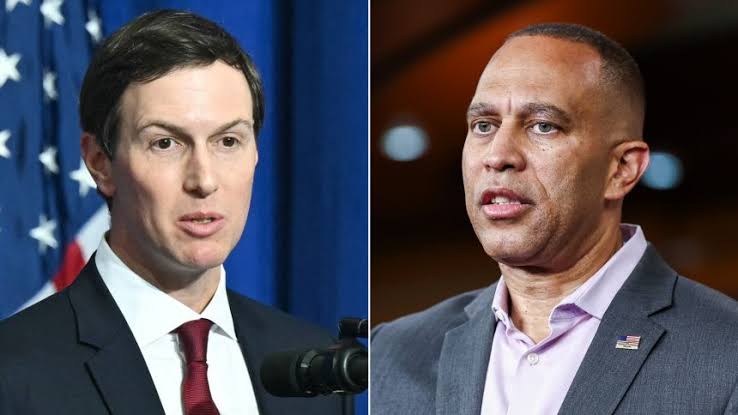
By: Said Arikat
September 2, 2026
News Analysis
Washington, D.C- The private meeting last month between House Minority Leader Hakeem Jeffries and Jared Kushner may eventually be remembered as little more than a Washington curiosity. But it could also prove an early marker of a much larger struggle over the future of the Democratic Party: whether its leadership consolidates around an establishment, pro-Israel and pro-AIPAC center, or whether an increasingly assertive progressive base forces a broader realignment.
Jeffries says Kushner requested the meeting and that they discussed affordability, housing and immigration. He has defended the encounter as consistent with his belief that Democrats should solve problems rather than simply score political points. If Democrats regain the House, he says, the Trump administration will face aggressive oversight. In his telling, the meeting was neither an accommodation nor a concession.
But politics is also about symbolism—and the symbolism was difficult for many Democrats on the left to ignore.
The meeting came just days after Jeffries said he no longer supports Medicare for All, despite having once co-sponsored the legislation. To progressive activists, the combination reinforced a troubling pattern: a Democratic leader increasingly comfortable engaging powerful establishment figures while distancing himself from policies that energize the party’s grassroots.
That matters because Jeffries is widely expected to become Speaker if Democrats retake the House. With a potentially narrow majority, he would need both centrists and progressives to keep his coalition together. The Kushner controversy therefore risks highlighting the very divide he may soon be required to manage.
But the deeper issue is not Kushner. It is Israel.
Jeffries has become one of the Democratic Party’s most prominent defenders of the traditional U.S.-Israel relationship and has maintained close ties with AIPAC. For years, that position placed him comfortably within the party’s mainstream. But that consensus has weakened dramatically, particularly among younger Democrats and progressive voters following the devastation in Gaza.
More than 100 House Democrats recently backed legislation seeking to restrict U.S. military assistance to Israel—an extraordinary measure of how far the party’s internal debate has shifted. Jeffries opposed the legislation while also arguing that Prime Minister Benjamin Netanyahu’s government must change course.
That balancing act may become increasingly difficult.
AIPAC remains a formidable force on Capitol Hill, but its standing among Democratic voters is changing. Progressive candidates have shown that challenging AIPAC-backed politicians can be electorally viable, while younger Democrats have grown increasingly skeptical of what they view as unconditional U.S. support for Israel.
Against that backdrop, the Jeffries-Kushner meeting raises a broader question: Is the Democratic establishment preparing to consolidate around a centrist coalition capable of confronting Trump while also containing the party’s left?
There is an additional irony in the relationship. Jeffries and Kushner both have ties to the prestigious New York law firm Paul, Weiss, Rifkind, Wharton & Garrison. Jeffries worked there as a litigation associate, while Kushner was a summer associate. They did not overlap, so the connection should not be overstated. Still, it places both within the same universe of elite New York legal and political networks, where relationships across ideological lines are hardly unusual.
That may help explain why Jeffries sees a meeting with Kushner as routine political business. For much of the Democratic grassroots, however, it looks increasingly out of step with the political moment.
The party’s progressive voters are demanding a more confrontational approach to concentrated wealth, corporate power and entrenched political influence. On Israel, they want a fundamental reassessment of policies Democratic leaders once regarded as largely untouchable. On healthcare, many continue to favor universal coverage over incremental reform. And on economic policy, support is growing for more aggressive redistribution and a stronger challenge to entrenched wealth.
Jeffries’ risk, therefore, is not that one meeting will alienate the left. It is that the meeting could become a symbol of something larger: a Democratic leadership more interested in managing existing power relationships than challenging them.
That could become particularly consequential if Democrats win the House.
A narrow majority would give progressives significant leverage. If they conclude that the leadership is unwilling to accommodate their priorities, they could use the Speaker’s election, committee assignments, legislation and primary challenges to force concessions. Israel policy could become one of the party’s defining internal battlegrounds.
Indeed, any attempt to consolidate the Democratic Party’s traditional pro-AIPAC wing could produce the opposite of its intended effect. It could intensify progressive primary challenges against incumbents, mobilize younger voters around Gaza and Israel, and turn AIPAC itself into a symbol of the establishment that activists are seeking to displace.
Jeffries thus faces a delicate calculation. He must preserve the institutional and political relationships that helped propel him to the top of House Democrats while convincing the party’s left that it has a meaningful place in his leadership.
Ultimately, the distinction between pragmatism and accommodation will be judged by results.
If Jeffries can engage figures from Trump’s orbit, negotiate when useful, and still pursue aggressive oversight, defend Democratic priorities and respond to the concerns of progressive voters, the Kushner meeting may eventually look like smart political pragmatism.
If, however, it becomes part of a broader pattern—closer ties to establishment power, continued reliance on traditional pro-Israel networks and retreat from progressive priorities—the backlash could be far more consequential.
The central question, then, is not why Jeffries met Kushner. It is what the meeting reveals about the Democratic Party he intends to lead.
The party is already undergoing a profound identity struggle. One faction seeks to preserve a broad establishment coalition encompassing Wall Street, corporate interests, traditional pro-Israel organizations and moderate voters. Another increasingly influential faction wants a more populist party—less dependent on wealthy donors and lobbying groups, more skeptical of U.S. military intervention and substantially more critical of Israeli policy.
Jeffries stands at the center of that collision.
Jeffries’ meeting with Kushner may have been routine political business, but if it comes to symbolize the consolidation of the Democratic Party’s establishment and pro-AIPAC wing at a moment when its grassroots are moving in the opposite direction, it could prove politically explosive. The resulting backlash would ultimately be about far more than one meeting—it would be about who gets to define, and ultimately control, the future of the Democratic Party.

