

“Free Palestine”: When Expressing Support for Freedom Comes at a Cost in America

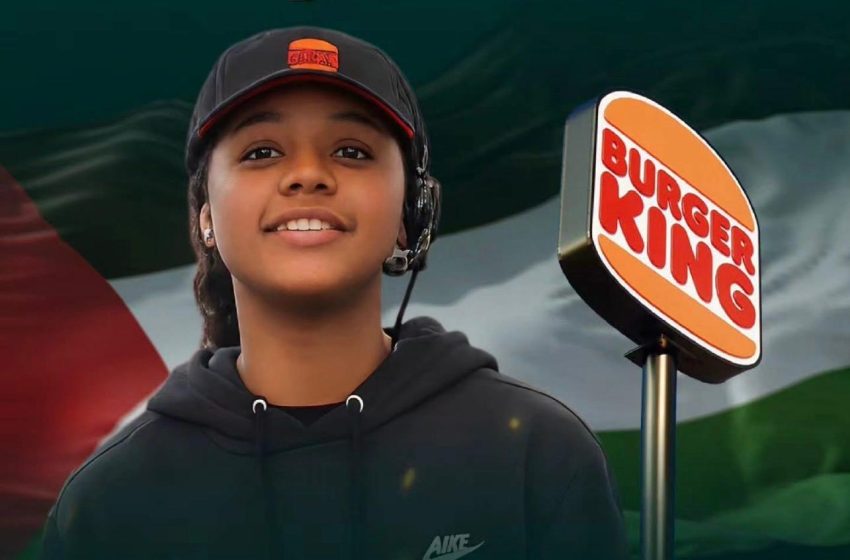
By Fatmeh Atieh – Al Enteshar Al Arabi
Standing for what one believes is right can come at a price—and sometimes, standing in solidarity with others can cost even more, even in a country that presents itself to the world as a land of freedom and free expression.
An incident at a Burger King restaurant in Pennsylvania has sparked widespread debate on social media after an employee, Ariana Hamilton, was seen telling a customer: “Free Palestine.”
According to accounts and videos circulated online, the customer was Israeli-American musician Rami Feinstein. Feinstein said he told the employee that he was from Israel, after which she responded, “Free Palestine.” In a video he later posted, he questioned whether Burger King was a “safe” place for Jewish customers.
Hamilton, however, gave a different account of some details of the encounter. She said the customer initially told her he was from New Jersey before identifying himself as Israeli, prompting her to respond with “Free Palestine.” She maintained that her statement was not intended as an attack on him because of his religion, but rather as an expression of her political position regarding Palestine.
What has drawn particular attention is that the statement captured in the widely circulated video was simply “Free Palestine.” The phrase itself did not contain an insult against Jews or a direct attack on Judaism.
This raises a broader and increasingly important question: When does expressing support for the freedom of a people or opposition to occupation become classified as hate speech? And does calling for Palestinian freedom automatically constitute hostility toward Jewish people?
Burger King said in a statement that it wants all guests to feel welcomed and respected and that it does not tolerate antisemitism, hatred, or discrimination. The company said it was working with the franchise operator responsible for the restaurant to address the incident.
Following the confrontation, Hamilton lost her job. According to reports and statements from supporters, she was told that the decision was related to allegations of discrimination or hate speech.
Her dismissal, however, produced a reaction that those involved may not have anticipated.
Within days, Hamilton became the focus of a major solidarity campaign, with supporters raising money to help her cover rent, bills, and living expenses while she searched for new employment. The fundraising campaign quickly attracted tens of thousands of dollars in contributions.
The incident therefore became about much more than one employee, one restaurant, and one customer. It reopened a growing American debate about Palestine, political speech, and the increasingly controversial tendency to blur the distinction between criticism of Israel, advocacy for Palestinian rights, and antisemitism.
Legally, freedom of speech in the United States does not mean that employees of private companies are absolutely protected from workplace consequences. The First Amendment primarily restricts government action and generally does not prevent private employers from establishing workplace conduct policies.
But the issue does not end with the legal question.
The law is one thing. The political and social climate is another.
When saying “Free Palestine” can contribute to an employee losing her job, it is legitimate to ask whether expressing support for Palestinian freedom has become, in some American institutions and workplaces, a political position carrying professional and social consequences.
At the same time, the widespread public support for Hamilton demonstrates that American society does not speak with one voice on this issue. A growing number of Americans reject the idea that solidarity with Palestinians should automatically be equated with hostility toward Jewish people.
There is an important distinction between Judaism as a religion and Jewish identity, on the one hand, and the State of Israel and its government policies, on the other.
Ariana Hamilton lost her job.
But in doing so, her case led thousands of people to repeat the same two words at the center of the controversy:
Free Palestine.

