

Climate Experts Warn of Escalating Extreme Weather, Urge Stronger Community Resilience

American Community Media Briefing – July 17, 2026
By Al Enteshar Al Arabi
As extreme heat, wildfires, floods, and severe weather continue to affect communities around the world, climate scientists and community leaders warned that climate change is no longer a distant threat but a daily reality that demands immediate action. Their remarks came during an American Community Media (ACoM) briefing held on July 17, where experts discussed the growing climate crisis, its impact on vulnerable communities, and the role of the media in improving public understanding.
Climate Change Is Making Extreme Weather More Dangerous
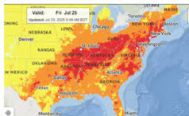
Professor Karen McKinnon, Associate Professor of Statistics and the Environment at the University of California, Los Angeles (UCLA), said recent extreme weather events—including record-breaking heat waves in Europe, dangerous heat across the eastern United States, Canadian wildfire smoke, and the anticipated return of El Niño—highlight the accelerating effects of climate change.
She explained that while El Niño is a naturally occurring climate pattern, its impacts are becoming more severe because it now develops in a world that is already significantly warmer due to human-caused climate change.
McKinnon noted that today’s atmosphere holds more moisture and retains more heat than in previous decades, increasing the likelihood of more intense heat waves, heavier rainfall, stronger storms, and faster-spreading wildfires.
“Virtually every major heat wave we experience today is hotter because of climate change,” she said, adding that scientific advances now allow researchers to identify the climate change “fingerprint” behind many extreme weather events with much greater confidence than ever before.
Communities on the Front Lines
Sheena Robinson, Resilience Project Director at the Asian Pacific Environmental Network (APEN), emphasized that low-income families, immigrants, refugees, and communities of color often bear the greatest burden of climate disasters despite contributing the least to global emissions.
She highlighted APEN’s work developing Community Resilience Hubs—local centers designed to help neighborhoods prepare for and recover from emergencies. These hubs provide backup solar power, battery storage, air filtration systems, emergency cooling centers, community kitchens, and disaster preparedness training.
One of the organization’s flagship projects is the Lincoln Recreation Center in Oakland’s Chinatown, which is being transformed into one of the nation’s first municipal resilience hubs. The facility will continue serving residents during heat waves, wildfire smoke events, and power outages while providing year-round community services.
Robinson stressed that climate policies should be communicated through issues that matter most to residents, including public health, safe housing, clean air, and protecting children, rather than relying solely on technical environmental terminology.
Building Resilience Worldwide
Mark Valentine, Senior Advisor to the Omega Resilience Awards, discussed how communities across Africa, Latin America, and Asia are developing innovative local solutions to climate challenges.
He described climate change as part of a broader global “polycrisis,” where environmental, economic, and political pressures increasingly overlap. According to Valentine, strengthening local leadership and supporting community-based solutions are essential for adapting to future climate impacts.
He also noted that while the media frequently reports on heat waves, floods, and wildfires, these stories often fail to explain their connection to climate change.
The Role of the Media
Throughout the briefing, panelists encouraged journalists to move beyond simply reporting disasters and instead help audiences understand the relationship between extreme weather and long-term climate trends.
They also urged news organizations to highlight practical solutions, amplify the voices of affected communities, and report on local efforts that strengthen resilience and preparedness.
A Call for Action
The discussion concluded with a clear message: climate change is already reshaping everyday life, and both mitigation and adaptation are urgently needed.
Experts agreed that reducing greenhouse gas emissions remains essential, but communities must also invest in practical measures—including resilient infrastructure, emergency preparedness, cleaner energy, urban tree cover, and public education—to protect lives as climate risks continue to grow.
As climate-related disasters become more frequent and more severe, speakers emphasized that informed communities, effective communication, and local resilience will be critical in meeting one of the defining challenges of the 21st century.

