

When Detention Echoes Occupation

By: Said Arikat
April 2, 2026
News Analysis
Washington, D.C-In public debates about immigration, detention is often described in sterile, bureaucratic language that obscures the lived reality behind the policy. The story of Leqaa Kordia, a 33-year-old Palestinian woman recently released after a year in a Texas immigration detention center, cuts through that abstraction with unsettling clarity. Her experience forces an uncomfortable question: what does it mean when someone who grew up under military occupation draws parallels between that life and time spent in United States custody?
Kordia was arrested by Immigration and Customs Enforcement in April 2025 after attending a protest against Israel’s war in Gaza outside Columbia University the previous year. The initial charges tied to the protest had already been dropped, yet her encounter with the system was only beginning. Despite having lived in the United States for nearly a decade, having no criminal record, and actively pursuing legal residency through her United States citizen mother, she was placed in immigration detention. What followed, by her account, was not an administrative inconvenience but a prolonged ordeal marked by indignity, neglect, and isolation.
Her reflections carry particular weight because she does not present herself as a seasoned activist. She describes herself simply as someone responding to devastating personal loss. More than 200 members of her extended family were killed in Gaza. Her protest, she insists, was not ideological performance but an expression of grief and a demand for recognition. Yet it is precisely this personal lens that sharpens her critique. She draws a direct line between systems that, in different contexts, reduce human beings to numbers, deny them basic dignity, and normalize suffering.
As a child in the West Bank during the second intifada, Kordia experienced the constant pressure of military occupation: checkpoints, curfews, armed raids. One memory stands out. At nine years old, she awoke to soldiers in her bedroom, one of them laughing while pointing a rifle at her face. It is a moment that has stayed with her not only for its terror but for the casual cruelty it revealed. Years later, in a detention facility in Texas, she says she encountered echoes of that same indifference. Guards, she recalls, dismissed requests for help, told detainees to be quiet, and sometimes laughed at their distress.
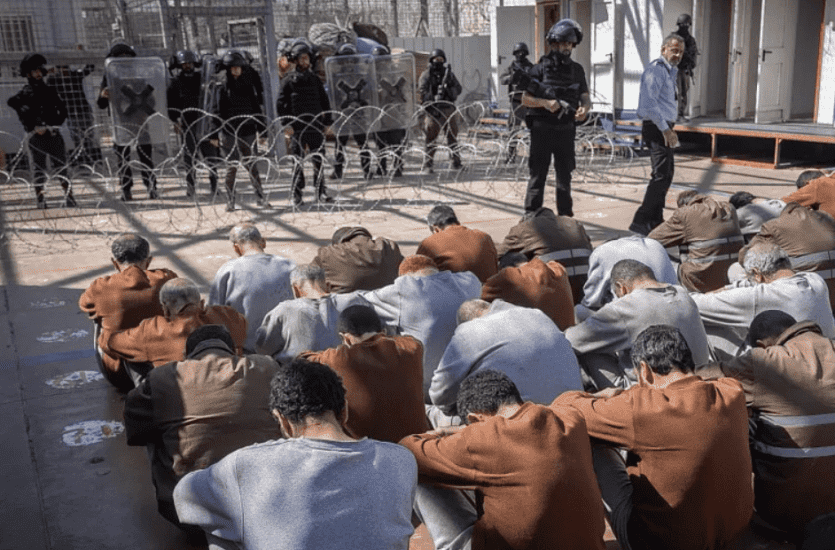
The comparison is not about equivalence of scale or context, but about patterns of dehumanization. Kordia describes overcrowded dorms where women slept on thin mattresses on the floor, frigid temperatures justified as a safeguard against germs, and water that was sometimes visibly contaminated. Meals were served at odd hours and often described by detainees as inedible. Those who refused to eat risked punitive isolation under the label of suicide watch. Basic religious accommodations were disregarded. Medical care, she says, was dangerously inadequate, culminating in her hospitalization after a seizure.
Such conditions, if accurately described, should not be controversial to condemn. Yet public understanding of immigration detention remains shallow. Kordia herself believed she was informed before her incarceration. Only after experiencing it did she grasp the extent of the problem. This gap between perception and reality is sustained by distance, by language, and by a tendency to treat detainees as abstractions rather than neighbors.
One of the most striking aspects of her account, however, is not only the suffering but the solidarity that emerged within it. Women from different countries, speaking different languages, formed a community under pressure. They shared food, celebrated birthdays with whatever they could gather, and looked after one another in moments of illness or crisis. When Kordia was hospitalized, it was another detainee who ensured her family was informed and who insisted that her hijab accompany her. In a system seemingly designed to isolate, they built connections.
Kordia now speaks of having a bigger family, one that includes the women she left behind in detention. This shift in perspective has expanded her sense of responsibility. While she continues to advocate for Palestinians, she now feels compelled to speak out about what she calls the human tragedy of immigration detention in the United States. Her testimony suggests that these issues are not separate but interconnected through a broader concern with how institutions wield power over vulnerable populations.
Critics may argue that such comparisons are inflammatory or overly simplistic. But dismissing them outright risks ignoring the underlying grievances they express. When individuals who have experienced different systems of control identify similar patterns, their observations deserve scrutiny, not reflexive rejection. The question is not whether the United States is identical to any other context, but whether its practices align with its stated values.
Kordia arrived in America believing it to be a place defined by freedom of expression and opportunity. That belief has been shaken but not entirely extinguished. She still speaks, still hopes, and still insists on the possibility of change. Her uncertainty about her own future, as her deportation case continues, underscores the precariousness faced by many in similar situations.
At minimum, her story challenges complacency. It asks policymakers, citizens, and observers alike to look more closely at what is done in their name. Detention, after all, is not merely a legal status; it is a human experience. And as Kordia’s account makes clear, it is one that demands far greater attention, accountability, and ultimately, reform.

