

Gaza Is the Prototype of a World Where Power Overrides Law

By: Said Arikat
March 31, 2026
News Analysis
Washington, D.C- Chris Hedges, speaking at Princeton University last week, offered a stark warning in his lecture, “Iran and Gaza Are Only the Beginning.” The wars unfolding in Gaza, and now radiating outward toward Iran and Lebanon, are not discrete crises. They are the visible architecture of an emerging global order—one in which power, not law, determines outcomes.
For decades, the post–World War II system held out the promise—however imperfect—of rules constraining force. Institutions such as the United Nations and the International Court of Justice were meant to embody that aspiration. Today, they persist largely as symbols. When their rulings align with the interests of powerful states, they are invoked. When they do not, they are ignored. The result is not the collapse of order, but its transformation into something colder: a hierarchy enforced by strength, with legality applied selectively.
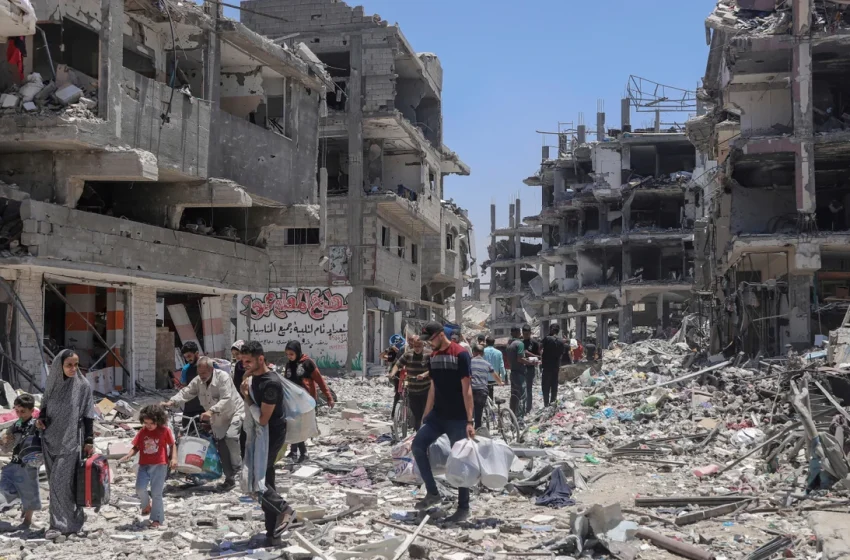
Nowhere is this transformation clearer than in Gaza. What is unfolding there is not simply war—it is a model. Overwhelming force is deployed with minimal restraint. Legal language is manipulated or avoided altogether. Narratives are tightly controlled. The cumulative effect is to normalize a form of warfare that would once have been widely condemned. Gaza is not an exception to the rules; it is evidence that the rules themselves have changed.
The expanding confrontation with Iran reflects the same logic. The rationale shifts—nuclear containment, missile threats, regime change—depending on political need. This fluidity is not confusion; it is strategy. As Hedges suggests, the objective is not reform but fragmentation: the systematic weakening of states into smaller, more controllable units. The precedents are well established in Iraq, Libya, and Syria, where intervention produced not stability but durable disorder. Such disorder is not incidental. It prevents the emergence of regional rivals and locks entire societies into cycles of dependency and crisis.
At the center of this dynamic is the convergence of long-term strategic agendas. Benjamin Netanyahu has spent decades advocating confrontation with Iran. That vision aligned, at a critical moment, with Donald Trump’s willingness to embrace risk and discard diplomatic constraints. But the significance of this alignment extends beyond individuals. It reflects a deeper continuity within political and military institutions, where strategic objectives persist across administrations, insulated from meaningful public accountability.
Hedges also directs attention to a more subtle, but equally powerful, instrument: historical memory. The Holocaust, one of the defining moral catastrophes of the modern era, is frequently invoked in ways that flatten complexity into binary categories of victim and perpetrator. Drawing on Primo Levi (the Italian Jewish author and Holocaust specialist) , Hedges warns that such framing obscures the ambiguities of human behavior and enables contemporary actors to claim moral immunity. In the context of Gaza, this selective memory can function as a shield, placing certain forms of violence beyond scrutiny.
This is not a new phenomenon. As Aimé Césaire ( the Afro-Martiniquan French poet and author), argued, the extreme violence associated with European fascism did not emerge in isolation—it was rooted in practices long deployed in colonial settings. What appears exceptional is often a continuation. Gaza, in this sense, sits within a broader historical continuum in which technological advances—precision weapons, surveillance systems, bureaucratic coordination—refine rather than replace older patterns of domination. Violence becomes more efficient, more distant, and, for those not directly affected, more abstract.
Equally important is the domestic dimension. Sustained external violence requires internal adaptation. Democratic safeguards—independent media, dissenting voices, institutional checks—must be weakened or bypassed. Language plays a central role. Terms such as “genocide” or “ethnic cleansing” are avoided, debated, or diluted, even when the scale of destruction demands clarity. This linguistic narrowing does more than shape perception; it structures what can be politically acknowledged. Over time, it erodes the capacity for moral judgment itself.
The relationship between foreign policy and domestic governance is therefore reciprocal. As states expand their ability to act without constraint abroad, they cultivate similar flexibility at home. Surveillance increases. Dissent is stigmatized. The boundaries of acceptable discourse contract. What begins as an external exception becomes an internal norm.
Gaza, then, is not only a humanitarian catastrophe. It is a prototype. It demonstrates how overwhelming force, narrative discipline, and selective legality can be combined into a coherent system—one that can be replicated elsewhere with minimal consequence. Iran and Lebanon are not separate theaters; they are extensions of the same model.
The implications are profound. If this trajectory continues, the distinction between lawful and unlawful violence will lose practical meaning. Accountability will become contingent, applied to the weak and withheld from the strong. International institutions will persist, but as instruments of legitimating rather than constraint. The language of human rights will remain, even as its substance erodes.
What is at stake is more than regional stability. It is the viability of the idea that power can be governed by law. If that idea collapses, so too does the framework that has—however inconsistently—limited the scale and frequency of mass violence in the modern era.
Hedges’ warning is ultimately about recognition. The danger lies not only in the actions themselves, but in their normalization. When societies accept that some lives are beyond protection, that some laws need not apply, and that some wars require no justification, they participate in the construction of a world where restraint is no longer expected.
That world is no longer hypothetical. It is already taking shape.

